Showing posts with label angles. Show all posts

Wednesday, May 4, 2011

Jomari's Post for May 4, 2011

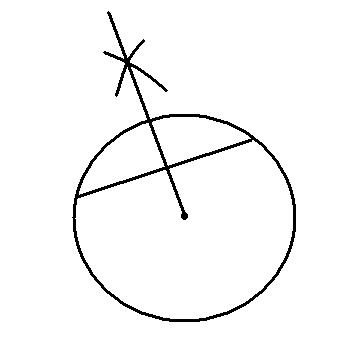
Today we learned about perpendicular bisectors.
These are lines that bisect straight lines at 90°.
Here's how to make one:


We made these bisectors for several chords.

In a circle, we don't need to make crossed arcs on one side of the chord because of the center.
After wards, we answered a problem involving bisectors. It was similar to this:
A wheel is stuck in some water. The radius is 22cm and the water takes up 34cm lengthwise of the wheel. How deep is the wheel?
This is what we have to work with:

This question was difficult because of the way it was drawn, but he then realized we could do this:

WE COULD USE THE PYTHAGORAS THEOREM TO FIND B
a
²+b²=c²
17
²+b²=22²
289+b²=484
b²=484-289
b²=195
√ b²=√ 195²
b=13.96

22cm-13.96cm=8.04cm
THE WHEEL IS 8.04cm deep into the water

Tuesday, May 3, 2011

Scribepost May 3, 2011

Today in Math, we continued on circle geometry.

Basically, Backé taught us more on how to figure out the the angle of an inscribed angle by looking at its central angle. He also gave us words and diagrams that we need to know.

First, he showed us something we should know already. Here are kinds of triangles according to sides.....

Equilateral Triangles are triangles with 3 equal sides, Isosceles Triangles have 2 equal sides, while Scalene Triangles have no sides equal.

....and here are other triangles according to their angles.

Acute Triangles have 3 acute angles, Right triangles have 1 right angle and 2 acute angles, Obtuse Triangles have 1 obtuse angle and 2 acute angles.

He mentioned the word "Theta" which means an unknown angle.

Then he gave us this table....

It simply means that
  • an angle that has an angle between 0 and 90 degrees is called an acute angle.
  • an angle that has an angle of 90 degrees is called a right angle.
  • an angle that has an angle between 90 and 180 degrees is called an obtuse angle.
  • an angle that has an angle of 180 is called straight angle.
  • angles that has an angle between 180 and 360 are called reflex angles.
wait there's more...


He also showed us facts about the total angle of polygons.
- sum of all angles of a triangle = 180 degrees
- sum of all angles of a quadrilateral = 360 degrees

------------------------------------------------------------------------------------------------
That is about it. Comment if I did anything wrong or if I missed stuff.

***Bring a PROTRACTOR with you because we'll be needing it in this chapter***

Monday, May 2, 2011

Hannah's post for May 2, 2011


So today we started on chapter 10, which is all about angles in a circle.

For starters, some words that we need to know are:

1. chord: a line segment with both endpoints on a circle

2. central angle: an angle formed by two radii of a circle

3. inscribed angle: an angle formed by two chords that share a common point

4. arc (of a circle): a portion of the circumference

We drew four different diagrams in class. All of which involving a circle.
They're subtended by the same arc. In other words, they share a common end point.


Homework for tonight is..
  • read pg. 382 Key Ideas
  • CYU #1
  • Practice and apply
  • Extend 18, 19, 20
  • Extra Practice
  • Homework book


Monday, December 13, 2010

Connor's Scribepost for December 13, 2010


Today in class we learned more on corresponding angles and how to find the length of sides.

First we corrected the tests.


Then we moved onto corresponding angles.


The corresponding angles are the sides that overlap when the triangle is flipped over the line of reflection.


The two sides that are marked blue are corresponding and the two sides marked yellow are corresponding.
After we reviewed the what corresponding angles are we went onto a quetion involving it.

The question was to find the value of X on the larger triangle.


First you must write the corresponding angles formula.

Next convert the two angle fractions with the measurements given in the question. (Image Below)


Next you must cross multiply.
4.7 (x) = 4.7x
13.7 (7) = 94.5


The answer to this question is x = 20.11

Next we did another question involving overlapping triangles.


The question was asking you to find the height of the ramp if it gives you the height of a support beam.
We need to convert the (cm) to (m)
50cm = 0.5m
Again we must find the side formulas.
(CD/AB) = CE/AE = (DE/BE)
Take the first and third side ^ because that is the measurements that is gives us.
50/x = 175/85
then convert to metres.
0.5/x = 1.75/(1.75+0.85)
Then we cross multiply.
1.75x = 0.5(2.6)
1.75x/1.75= 1.3/1.75
x= o.74m
Then we convert it into cm again which is 74.29cm.
The height of the ramp is 74.29cm.
Sorry if you cant understand some of the math written is hard to understand. I tried the best i could in the time I could. Comment if you have any questions.
The next person for the scribe is Maryjhane

Sunday, December 12, 2010

Elijah's Scribepost for December 10 2010

In class today, we classified triangles by its sides, and angles. We also learned more about SAS (side, angle, side).
Classifying Triangles by side:
  • Scalene: All Sides are different
  • Isosceles: 2 sides are the same.
  • Equilateral: 3 sides are equal.

Classifying Triangles by Angle
  • Right angle: One angle equals 90°
  • Obtuse angle: One angle's greater than 90°
  • Acute angle: All angle's are less than 90°
  • Equiangular: All angles equal 60°

Other Tringle facts

  • All triangles have an interior measure that sums to 180°
  • Right triangle:


  • Equiangular :

  • Obtuse :
  • Acute :


SAS (side, angle, side):
If sides and angles are proportional the triangles are similar.


Then we got to solve a problem: Find the b and the h.


Solve:
The next problem is based on a right triangle. Find the a b and c
Solve:


Homework :
Extend 18 and 20
Homework book/ Extra practise