Showing posts with label rational numbers. Show all posts

Wednesday, November 17, 2010

Question 12

12. In the table, a positive number shows how many hours the time location in ahead of the time in London, England. A negative number shows how many hours the time is behind the time in London.


*First of all: remember that in adding and subtracting fractions, you must find a common denominator first (if needed).

a) How many hours is the time in St. John's ahead of the time in Brandon?

To find the answer, I subtracted the amount of time in Brandon from the amount of
time in St. Johns. A diagram below shows you how I solved it, and therefore the time in St. John's is 2 and 1/2 hours ahead of the time in Brandon.


b) How many hours is the time in Victoria behind the time in Mumbai?
The process in the same as the last question, I subtracted the time in Victoria from the one in Mumbai. Below, it shows that time in Victoria is 13 and a half hours behind from that of Mumbai.


c) Determine and interpret the time difference between Tokyo and Kathmandu.
Once again, I subtracted the two times of both places. The diagram below shows that Tokyo is 3 and 1/4 hours ahead of Kathmandu.

d) Determine and interpret the time difference between Chatham Islands and St. John's.
I subtracted the amount of time in Chatham Islands to that of St. John's. The diagram below will show that Chatham Islands is 16 and 1/4 hours ahead.


e) In which location is the time exactly halfway between the times in Istanbul and Alice Springs?
The time in Kathmandu, Nepal is halfway between times in the other two locations. How did I know that? Because I added the times in Istanbul and Alice Springs (refer to chart above) and then I divided their sum by 2 because we are finding the halfway point. (Half= 2)

Thank you for reading :)

Monday, November 15, 2010

Seppe's scribepost

Question 18, 2.4 on page 79

18. A frame measures 30 cm by 20 cm. Can you mount a square picture with an area of 500 squared cm in the frame? Explain.

Frame
= 30 x 20

Picture
= 500

So to find the sides of the picture, you have to find the square root of 500 which is 22.36.
One side of the picture is too big for the frame so the answer is no, it can't fit in the frame.

PLEASE COMMENT (IF YOU WANT) TO MAKE MY POST A BETTER ONE :D

Sunday, November 14, 2010

Jerick's Math Blog Post for 2.3 , November 14, 2010

Hey everyone ! This is my blog post for the question I was assigned for math
the question is ..

24. Can the sum of two rational numbers be less than both of the rational numbers? Explain using examples in fraction form .

The answer would be, yes the sum of two rational numbers can be less than both of the rational numbers, that is ,if the sum is negative.

Example:
(-3/4) + (-2/3 ) = -17/12 or -1 5/12

I have to admit, this question kind of confused me, so please, if anyone can explain it to me, I would gladly appreciate it
and
If you have any other examples, please feel free to put it as a comment
Thank You for Reading My Post

Tuesday, November 9, 2010

Michelle's Scribepost for November 9,2010

Hey everyone! Today in class we were given questions from the textbook. I had to do question 6 from 2.3.

First you find the common denominator. Sometimes when you multiply both denominators you can find the common denominator, but that doesn't always work because you want the least common denominator. For example, in questions b), d), and e) If you multiplied both the denominators, the denominator would be a big number. So you have to find the least common multiple.

The next step is, whatever you do to the bottom (denominator), you do to the top (numerator).

*Refer to a) Think how many times does 3 go into 12? 4 times, so you have to multiply both the numerator and denominator by 4. (2 x 4 = 8) Also with the other fraction (3/4), you find how many times does 4 go into 12? 3 times, so you multiply the denominator and numerator by 3.

Then after you changed the fractions which are now equivalent fractions, (still referring to a) you minus (or add, depending on the question) the numerators. (8-9= -1) and keep the denominator the same.

In question e) there are mixed fractions. One way to change mixed fractions into improper fractions is by, multiplying the denominator by the whole number and adding the numerator to get the NEW numerator. Keep the denominator the same.

In question f) you can just take the whole numbers and fractions and separate them. First you do the whole numbers 1 + (-1) = 0. Then you do the fractions like you would normally do it.


Sorry if this doesn't really make sense, I tried to explain it. And sorry for lack of colours, it doesn't work.

Hannah's blogpost

Hi guys!
So all my answers and everything, I just put them in images to make it easier, I guess. I know it's late but that is because I was having trouble at first trying to figure out how to get to the answers. I tried my best to explain how I got the answers. If I did anything wrong, tell me :) That's all


Thursday, November 4, 2010

Jamie's Blog Post for November 4, 2010

We were all assigned to do a blog on questions from the textbook and I got question 28 from 2.1.
Actually, I'm not too sure if Mr Backe assigned this question for me because it look me like 2 minutes to figure out.. But I'll do it anyways!

# 28: How many rational numbers are between 2/3 and 0.6 repeated? Explain.
Well, my answer would be none. That is because 2/3 and 0.6 repeated are equivalent.

Here, I'll show you different ways on how to answer this question.

I used the long division to convert the 2/3 into a decimal.
Once it kept going on and on, I knew that it was a repeating decimal which is 0.6 repeated. And, 0.6 repeated = 0.6 repeated, so there are no rational numbers that go inbetween 2 of the same numbers.

THANK YOU for reading my post and have a nice day! :D Please comment to tell me what I did wrong.

PS: Backe, if you would like to give me another question I'd be happy to. :P I like a little bit of a challenge! hahahahaa :D

PSS: Colours aren't working :(

Wednesday, November 3, 2010

The Mathimatical Mystery of Rational Numbers- Prime Suspect: Zero, Inspector: Laura K. Turner

Good evening fellow classmates. My name is Laura Turner and I am here to solve this mathematical mystery.

My challenge was to determine whether or not zero is in fact a rational number. After some hard thinking and research through our previous notes I have deduced that yes, zero does fall under the category of rational numbers. My reasoning is as follows:

Before beginning my investigation, I went through the mental knowledge I had of what rational numbers are and how they can be identified. I knew from previous math sessions with Mr. Backe that, in order for a number to be rational it must be able to be written as a fraction, where the denominator does not equal zero. After some time with my calculator I came to the realization that this is because anything divided by zero comes up as an error. AKA: UNDEFINED. However, thinking outside the box I experimented with various angles of the situation, including using zero as the numerator. After some more time with my calculator I was informed that zero divided by anything equals zero. This is the climax of the investigation.

Since determining that zero divided by any given number equals zero, I have come to the conclusion that zero is a rational number because it can be expressed as a fraction, and the denominator does not equal zero. Here is your evidence:

0/2 = 0

0/ 5= 0

0/ 123 456 789 = 0

As you can see, the theory works and can be tested on any number. Please feel free to investigate further at your own will. However, ladies and gentlemen I think that this case has been cracked. Thank you for your time.

-Detective Inspector Laura K. Turner

Camille's Math Blog Post

Today in math class we were assigned questions to post on the blog. I was assigned two questions , # 16 & 17.

#16) Identify a fraction between each of the following pairs of rational numbers.
a) 0.2, 0.3
You find the decimal that goes in between, which is 0.25.
You multiply it by a 100 because there are 2 numbers behind the decimal and to make it a whole number which is 25 over 100. Then you simplify, so divide it by 5 until you can simplify anymore. The answer is 1/4.


b) 0,-0.1
Find the number that goes in between, which is -0.05. You make it into a fraction, so -0.05 over 1. Then you multiply by 100 to get a whole number which is 5 over 100. Then you simplify, divide both bottom and top. The answer is 1 over 20.


c) -0.74, -0.76
Find the number that goes in between which is -0.75. Then you make it into a fraction. -0.75 over 1. You multiply it by 100, because there are 2 numbers after the decimal and also to make it a whole number. Which is -75 over 100. To simplify you divide it by 25, until you cant anymore. The answer is -3 over 4.


d) -0.52, -0.53
You find a number between which is -0.525. Then you turn it into a fraction. -0.525 over 1. You multiply by 1000 because there are 3 numbers after the decimal and to make it a whole number. So it would be 525 over 1000. Then you simplify by the common denominator which is 25. Divide both numerator and denominator by 25. The answer is -21 over 40.


#17)Identify a mixed fraction between each of the following pairs of rational numbers.
a) 1.7, 1.9
Find the number that goes in between which is 1.8. So we are making it into a mixed fraction, The answer would be 1 and 8 tenths because 1 is the whole number and the 8 is in the tenths place.


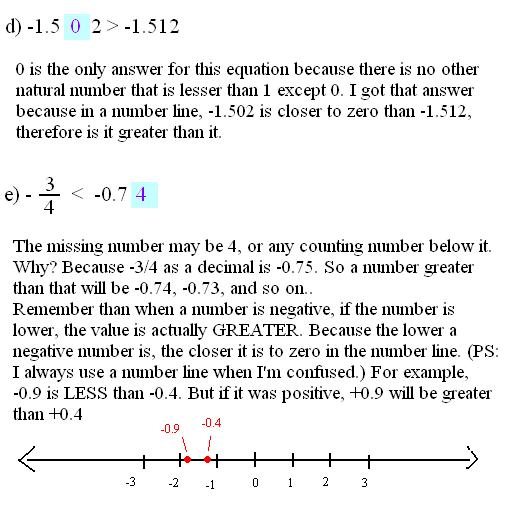
b)-0.5, 1.5
Find the number that goes in between which is -1. You make 1.2 in a mixed fraction so, 1 and 2 tenths because 1 is the whole number and 2 is in the tenths place. And also simplify, find a number that both go into 2 and 10, which is 2. So you divide it by 2. So the answer is 1 and 1 fifth.

c)-3.3, -3.4
Find the number that goes in between which is -3.35. You turn -3.35 into a mixed number, so it will be -3 and 35 hundredths, because 3 is the whole number and 35 is in the hundredths place.
d)-2.01, -2.03
The number that goes in between is -2.02. You turn -2.02 into a mixed number so it will be -2 and 02 hundredths, because -2 is the whole number and 02 is in the hundredths place.
OH and please remember to comment if i made any mistakes! Don't forget to play tut pup!


Wednesday, October 27, 2010

Alex's Post

Hurrah it's my post thanks Jo for switching it at the last minute.Its a day late but I'm still going to use the word today.
Okay today in class we made 2 foldables, yes 2, one was for the Real numbers, Natural, Whole, Integers, Rational, and Irrational numbers. I made the pictures in paint because it's too hard to take the pictures. The first image is the front and second page and the second is the inside of the 1st foldable. We basically just put what is in the set, what numbers go in each category, the numbers that don't belong in each set, and numbers we don't usually think of. For homework with this we were supposed to finish all the things we didn't do and add the definitions.


This lovely little picture here is the second foldable, well half of it at least. Mr. Backe explained how to multiply improper fractions, proper, and mixed numbers, and how to divided them as well.
The homework for this was to make 10 questions each for dividing and multiplying using the way he showed us.


Yeah yeah I know its not great but I'm me what did you expect. If you didn't understand something or I missed something leave a comment.
Oh yeah and as I said already today Josh, your doing the next one.
(reminder click on the images to enlarge.)

Wednesday, October 20, 2010

Jeric's Scribe Post for October 20, 2010


Hi guys, today in class we did some questions. The question was what numbers fit in between 1/8 and 1/10.


We will first start with 1/10.


Well first of all most people in our class said that 1÷10=0.1 which is true but then we were asked to do it another way. Jamie said that 1/2 of 1/4 = 1/2 x 1/4 = 1/8. Then I think Guiseppe said 1/4 / 2. What Guiseppe did was a complex fraction.


Then we were told that we could do it this way ...


We were first asked if 8 could go into 1 and common sense no. Then we were told that by adding a decimal point after 1 still means 1. But instead of looking at it as 1.0 just look at it as 10. But by adding the decimal we must also place the decimal in our answer and during our process of finding out what we did. So then we were then asked how many times does 8 fit into 10 and its 1. We then subtracted 1.0 to 0.8 to get 0.2. Since 8 can't go into 0.2 you can place another 0 after 0.2 to make it 0.20. It is still 0.2 but by placing the 0 it makes it look like its 0.20. So then we were asked how many times does 8 go into 0.20 and it equals 0.16. You then subtract 0.16 from 0.20 and get 0.04. Once again 8 does not fit into 4 but by placing a 0 in front of the 4 it looks like 0.040. We were then asked how many times does 8 go into 40 and it equals 5 times. We then subtract 0.040 by 0.040 which is 0. You then should have an answer of 0.125.


We then had to convert 1/10 into a decimal which was pretty easy.


Once again by placing the decimal it would look like 10. So then we were then asked how many times does 10 go into 10. We got 1 and then you subtract 1.0 from 1.0 to equal 0. You should then have an answer of 0.1.


Now that we have converted the fractions into decimals we then asked what numbers fit between 0.1 and 0.125.


We came up with answers like 0.101, 0.102, 0.103,0.104


These answers are correct. How do we know ? As long as the first 3 digits are the same then anything after the that is between 0.1 and 0.125.


Sorry if none of this makes sense.

Please comment, I am for sure i made mistakes and errors.


Thnx :D
I CHOOSE JOMARI FOR THE NEXT BLOG !!!


Tuesday, October 19, 2010

Sharmaine's Scribe Post

Today in math class, we had a quiz on Rational Numbers
We had five questions and they were:

1. Name a rational number equivalent to 5/25
A rational number that is equivalent to 5/25 can be
10/50, 0.2 , 1/5 and more because they all represent the same amount.


2. 6.7, 0.8, 0.666...., 3/4
Write in ascending order
Ascending means least to greatest, so the order would be
0.666... , 0.8, 6/7, 13/14

How i got this was i converted the fractions into decimals
6/7 =0.86
13/14 =0.92


3. Name a rational number that is not an integer.
that means that its can be expressed in a rational number but not a integer
so like 1.5, 1/5, 2/10, 3/10

4. Name the points at the balck and blue dots in the number line.
red = -5.5 blue = 3.2


5. The number 6 belongs to what group
N,W,I,Q, and R
natural numbers
whole numbers
integers

rationals (fractions)
real number

Once we were done that we wrote down notes on how convert a repeating decimal back into a fraction.

we started off by knowing how many periods a decimal would have.
for example - 0.14 reapeating, there are 2 period because there are two number that kept reapeating which would be 0.14141414..

if it was one number repeating there would just be one period.

Next we found out how to convert a repeating decimals into a fraction.
ex. 0.14... (repeating)
We mulitplied it by 100 to move 2 decimals places. It was now 14.14 repeating.
Next we subtract 100x by x too get 99. "x" is like an imaginary one

"x" is 0.14
Since there were two 14 together they canceled out leaving us with 14.
we are left with 99 = 14, so we divide it over 99 because there are 99 x's .
there were two 99 so they cancel out and your left with the fractional form 14/99


You would do the same if it was only one number repeating but instead you woild mulitply it but 10 to make in move two decimal places.

Homework:
- journal
- textbook questions (we'll have a work period tomorrow)


Please your correct me if im wrong and comment!
I chose jeric to do the next scribe!!

Monday, October 18, 2010

Connor's Blogpost for October 18

In Mr. Backe's math class today we started off with playing a new decimal version of our previous card game.

The operation used was addition. The game basically worked by all red cards were negative decimals, black cards were positive numbers and the face cards were 0.9 and its opposite. The cards were very simple because they were only decimals in the tenths place value and between
-1, 0, 1.

Then we continued on with making a new foldable.
We started 1/3 down the horizantal page with this image below.


If you cannot read this diagram, this is a list of what it says;
-Natural Numbers and Counting Numbers
Eg. 1,2,3,4,5,6,7,8,9
-Whole Numbers
Eg. All Natural numbers and 0
-Integers
Eg. All Numbers and the opposites
-Rational Number
Eg. All numbers that can be expressed in a/b, where a and b are integers but b cannot = 0
-Irrational Numbers
Eg. None terminating numbers, none repeating numbers, decimal numbers like Pi and square roots of none perfect squares.
-Real Numbers
Eg. All numbers in the chart excluding imaginary numbers.

The initials for the categories are;
Natural Numbers = N
Whole Numbers = W
Integers = I
Rational Numbers = Q
Irrational Numbers = Q' <--- The tick on the top right corner of the Q means prime.
Real Numbers = R

The Boxes represent that every smaller box inside the bigger box, fits under the bigger boxes category. For example Natural Numbers and Whole numbers fit under the Integers box. And all the boxes including Irractional numbers fit under the real numbers category.

This is as far as we have gotten on the foldable in todays math class.
Homework for tonight is;
Play tutpup
Decimal Booklet
2.1 Extra Practice
Text Book 2.1 Practice, Apply and Extend
Also if you havn't finished the above image on your foldable, complete that too.

THANK YOU for reading my post, Rate and Subscribe :) (Comment)

THE NEXT PERSON I PICK FOR THE BLOG IS SHARMAINE! (: